
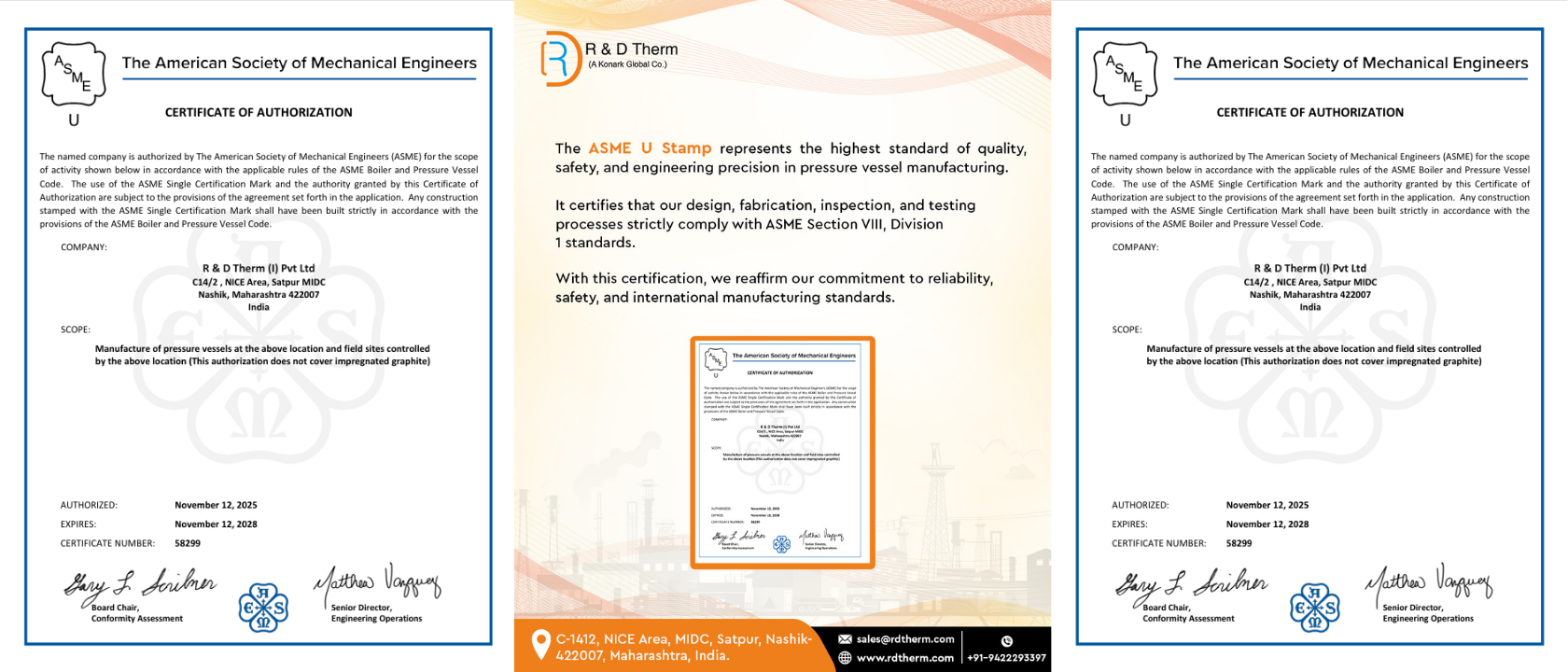
If you're sourcing pressure vessels, heat exchangers, or reactors for your plant, you've almost certainly seen the term "ASME U Stamp" on a manufacturer's website or quotation. It's often mentioned as a badge of quality — but most buyers never get a straight answer on what it actually certifies, why it matters, and how it should influence a purchasing decision.
This guide breaks down the ASME U Stamp in plain terms, so you know exactly what you're paying for and what risks you avoid by insisting on it.
What Is the ASME U Stamp?
The ASME U Stamp is a certification mark issued by the American Society of Mechanical Engineers (ASME) under its Boiler and Pressure Vessel Code (BPVC), Section VIII. It certifies that a manufacturer is authorized to design, fabricate, inspect, and stamp pressure vessels in accordance with ASME's engineering, materials, and quality standards.
In simple terms: a vessel carrying the U Stamp has been built by a company that ASME has formally audited and approved — not one that simply claims to follow the code.
The stamp itself is physically applied to the vessel's nameplate, along with a unique National Board number, making the equipment traceable for its entire operating life.
Why the Certification Exists
Pressure vessels store or process fluids and gases under pressure — conditions where a design flaw or fabrication defect can lead to catastrophic failure, not a minor equipment issue. The U Stamp program exists to make sure that risk is controlled at every stage:
Design — wall thickness, material selection, and safety factors are calculated to code, not estimated
Materials — every plate, forging, and weld consumable used must be traceable to a certified mill or supplier
Fabrication — welding procedures and welders must be individually qualified to ASME standards
Inspection — an Authorized Inspector (AI), independent of the manufacturer, reviews and signs off on the vessel before it ships
Documentation — a full data package (design calculations, material certs, NDT reports, hydro test results) is compiled and retained
None of this happens informally. A manufacturer must maintain a documented Quality Control System that ASME audits before authorization is granted, and re-audits periodically to keep it.
What This Means for You as a Buyer
1. You're buying accountability, not just a product. When equipment fails without proper certification, tracing the root cause — bad material, a bad weld, a design error — can be difficult or impossible. U Stamp documentation means every component of the vessel has a paper trail back to its source.
2. You reduce regulatory and insurance risk. Many jurisdictions and industries (oil & gas, pharma, petrochemical) require ASME-code equipment for statutory compliance or insurance underwriting. Installing non-code equipment can create liability exposure that has nothing to do with how well the vessel was actually built.
3. You get independent verification, not just a manufacturer's word. The Authorized Inspector isn't employed by the fabricator. Their sign-off means someone with no commercial stake in the sale has checked the vessel against the code before it left the shop floor.
4. You gain long-term traceability. The National Board number stays with the vessel for its operating life. If you need to re-rate, repair, or requalify the equipment years later — or sell the plant — that documentation trail matters enormously.
5. It signals manufacturing discipline beyond the stamp itself. A shop capable of sustaining ASME certification typically has broader quality systems in place — material traceability, welder qualification records, calibrated inspection equipment — that benefit every job they do, certified or not.
What to Actually Check When a Manufacturer Claims "ASME U Stamp Certified"
Not all claims are equal. Before you finalize a vendor, verify:
Current certificate status — ASME certificates are valid for three years and must be renewed; ask for the current certificate, not a historical one
Scope of authorization — some shops are certified only for specific vessel types, thicknesses, or materials; confirm your requirement falls within their scope
National Board registration — confirm vessels will be registered with the National Board of Boiler and Pressure Vessel Inspectors, not just stamped
Authorized Inspector arrangement — ask which Authorized Inspection Agency they work with
Material traceability practice — request sample Material Test Certificates (MTCs) from a past job to see documentation quality firsthand
How R&D Therm Applies ASME Discipline at Every Stage
Certification is only as meaningful as the process behind it. At R&D Therm, ASME code compliance isn't confined to final inspection — it's built into every stage of fabrication:
Material Traceability — every plate, pipe, and forging is tracked from mill certificate through to the finished vessel, so each component's origin and properties are documented and verifiable
Material Marking & Cutting — heat numbers and material identification are transferred and maintained through every cutting operation, ensuring no material ever loses its traceable identity on the shop floor
Forming & Machining — vessel shells, heads, and components are formed and machined to code-specified tolerances, with process parameters controlled and recorded
Welding — carried out strictly per qualified Welding Procedure Specifications (WPS), by welders individually qualified to ASME requirements, with each weld traceable to the welder and procedure used
Surface Preparation — surface finishing, cleaning, and treatment are executed to meet code and application-specific requirements, critical for corrosion resistance and product purity in pharma and chemical service
This stage-by-stage discipline is what the U Stamp is meant to verify in the first place — and it's why we treat it as a manufacturing standard to uphold on every job, not a certificate to produce on request.
The Bottom Line
The ASME U Stamp isn't a marketing sticker — it's evidence of a manufacturing and quality system that has been independently audited, and of individual vessels that have been independently inspected before delivery. For pressure equipment where failure isn't an option, that distinction is the difference between buying a vessel and buying assurance.
At R&D Therm (I) Pvt. Ltd., every pressure vessel, reactor, and heat exchanger we manufacture is built under our ASME code authorization, with material traceability, marking, welding, and surface preparation controlled at every step — not just checked at the end. If you're evaluating vendors for your next project, we're happy to walk you through our quality documentation before you place an order.
R&D Therm Engineering Desk
Have a process problem you'd like an engineer to weigh in on?
Drop us a note and one of our process or mechanical engineers will reply within one business day. No sales calls — just engineering.
